

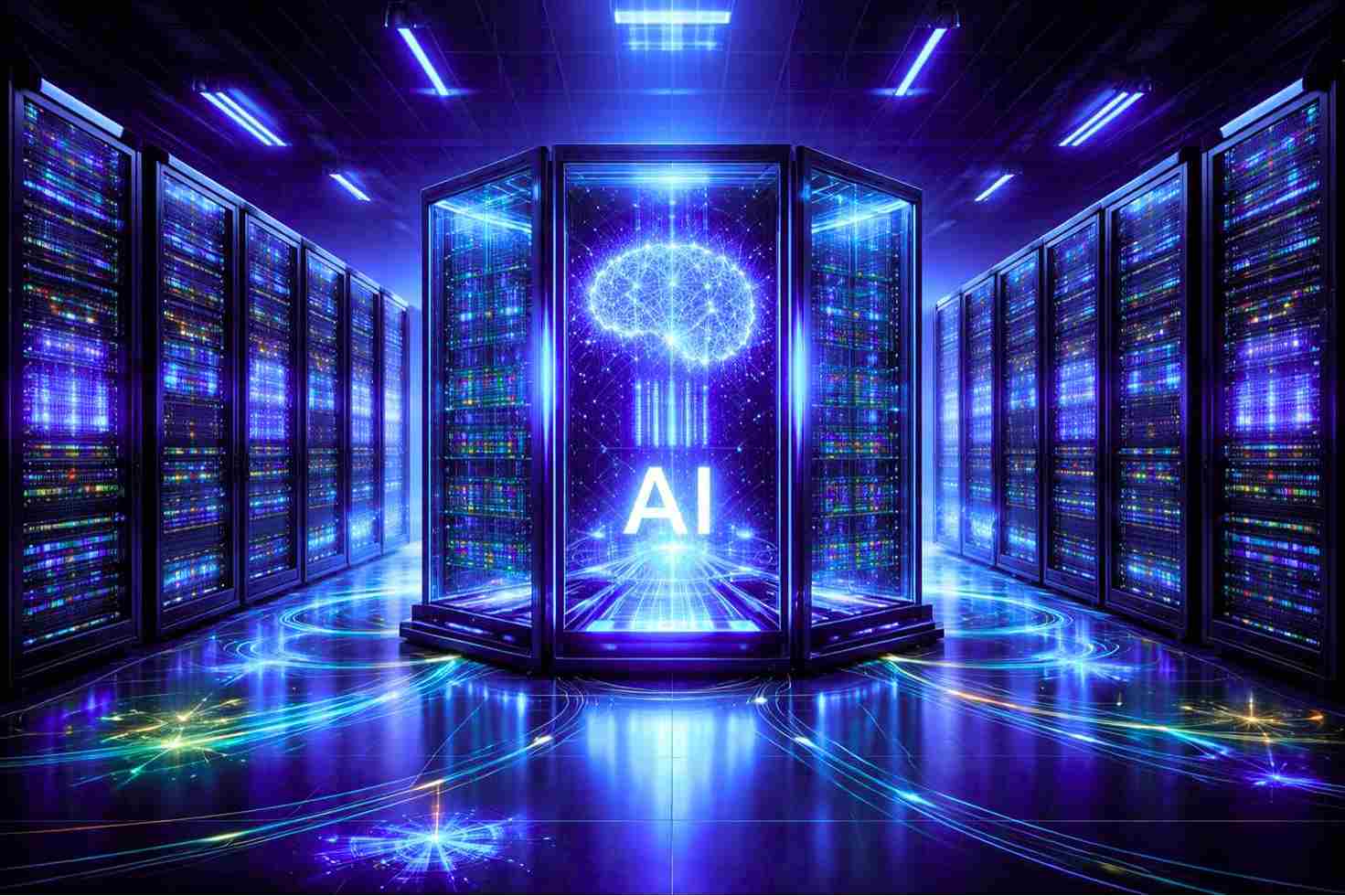
AI is accelerating at an unprecedented rate, and behind that speed lies huge amounts of processing power. AI supercomputers are machines that train huge models, process enormous data sets and solve problems that were once unthinkable. “Industries are now turning to AI supercomputing as the technological foundation for their future. Whether it’s healthcare, a broad range of scientific disciplines, climate modeling, finance applications or video games everything is limited by the double-edged sword of computational complexity.”
1. What Are AI Supercomputers
AI supercomputers AI-optimized high performance computing machines built for artificial intelligence workloads. Unlike typical computers, quantum computers have powerful processors, as well as advanced graphics cards and high speed memory to run complex calculations on an extreme scale. These systems are designed to train and execute complex AI models at large scales.
2. Why AI Needs Supercomputing Power
Current AI models are trained on huge amounts of data. Training these models requires billions or even trillions of computations. This is something regular servers would not be able to manage adequately. AI supercomputers cut months off training times, accelerating innovation and iteration.
3. How AI Supercomputers Are Built
AI supercomputers are outfitted with specialized hardware and architecture:
- Powerful GPUs and AI accelerators
- High speed interconnects between processors
- Massive parallel processing capabilities
- Advanced cooling systems
- Software frameworks tuned for AI workloads
This model enables them to perform decision-making tasks simultaneously and very rapidly.
4. Advancing the Frontiers of Science and Research
AI supercomputers are changing science research. They help model climate patterns, process genetic data and simulate complex physical systems. Scientists can also virtually try out ideas before performing real world experiments, saving time, cost and resources while speeding up discoveries.
5. Role in Healthcare and Medicine
In medicine, AI supercomputers model drug discovery and personalized treatment plans as well managing medical imaging. They crunch millions of data points to spot patterns that humans may miss, which can result in faster diagnosis, better treatment and more effective patient care.
6. Powering Business and Industrial Innovation
AI supercomputers are used by companies to offer competitive services. These systems can range from supply chain optimization, to fraud detection and customer insights which are able to analyze real time data at a petabyte scale. Finance, manufacturing and energy are among the industries applying AI supercomputing to increase efficiency and inform increasingly critical decisions.
7. Nurturing the Emergence of Generative AI
The generative AI model demands vast computational power. AI supercomputers make such models able to easily learn human language, images, audio or video with great precision. And as generative AI spreads into creative and professional tools, the demand for supercomputing power is only growing.
8. Energy Efficiency and Sustainability Challenges
But AI supercomputers are energy intensive. Power consumption and cooling are a headwind to keep in check:
- High electricity demand
- Heat generation from dense hardware
- Environmental consequences of Big Data Centers
- Need for renewable energy integration
- Pressure to optimize performance with out sacrificing efficiency
Cooling and energy control technology has been evolving to help solve these problems.
9. Accessibility and Global Competition
AI supercomputers are expensive and difficult to access. They consume vast resources of governments, research institutions and big companies. AI supercomputing is a national asset, so countries are racing to develop faster and more powerful systems.
10. The Future of AI Supercomputing
The future is faster systems that are also smarter. AI supercomputers will continue to be pushed forward by chip and quantum computing design, power efficient architectures. Their tech will gradually filter down to something that startups and smaller groups can also get their hands on.
Key Takeaways
Will the next era of breakthroughs be born on AI supercomputers? It powers scientific and compute breakthroughs in new areas of research that were previously infeasible – including drug discovery, space exploration, climate change research, business analytics and generative AI. Although there are still issues to solve in terms of cost and energy, improvements that make the systems more efficient and have greater impact are being made all the time. As A.I. becomes more integral to daily life, supercomputers will continue to serve as the engines chugging away behind the scenes powering progress ahead.
FAQs:
Q1. What is an AI supercomputer?
An Exascale AI System It is a distributed HPC system for scalable and robust execution of large scale AI applications.
Q2. Why are AI supercomputers important?
They can speed up training and deployment of sophisticated AI models significantly.
Q3. Who uses AI supercomputers?
They’re employed by governments, research institutions, health care organizations and big business.
Q4. Do AI supercomputers use a lot of energy?
Yes, it requires a lot of energy, but efficiency is in progress.
Q5. Will AI supercomputers be more available over time?
In the long run, innovations are likely to drive down prices and make devices more widely available.
